Türkiye's KAAN Stealth Fighter: Second Prototype Targets December First Flight
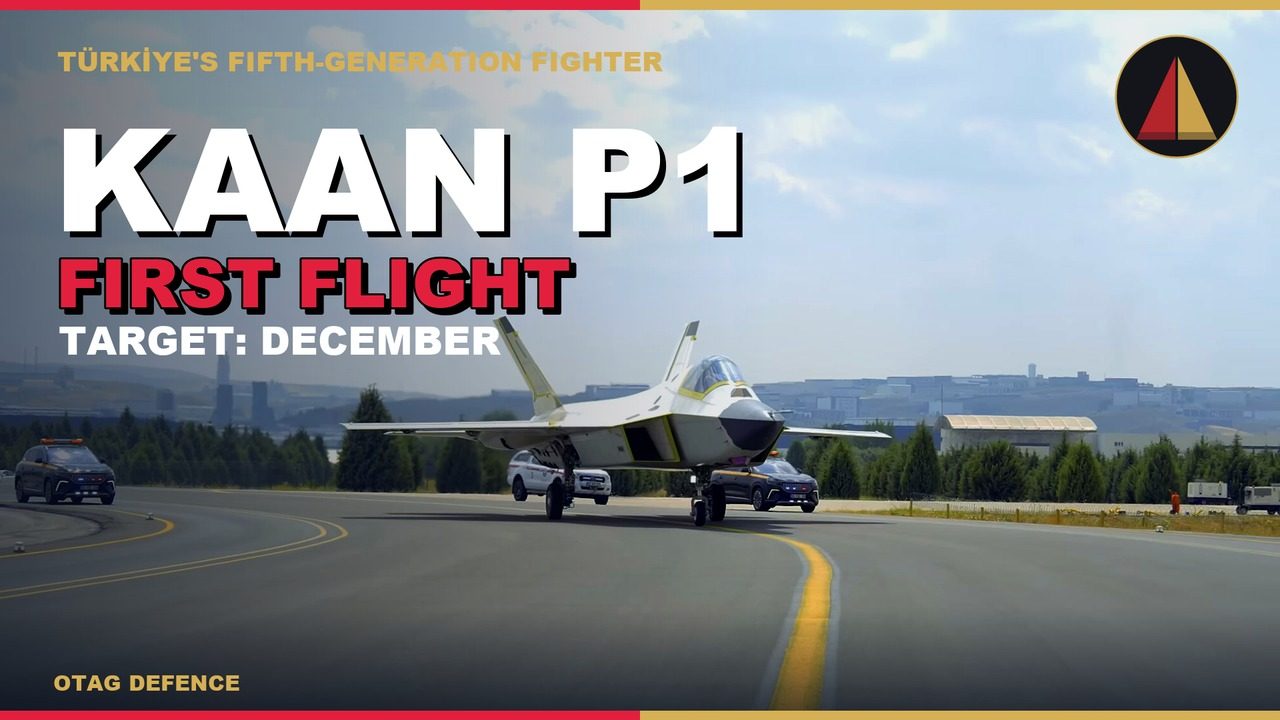
KAAN, Türkiye's fifth-generation fighter, has a second prototype that could make its first flight in December. Sources tell Otag Defence that Turkish Aerospace is targeting December for P1's maiden flight and aims to have P2 and P3 ready for flight testing in 2027. This is a target; the flight has not happened yet.
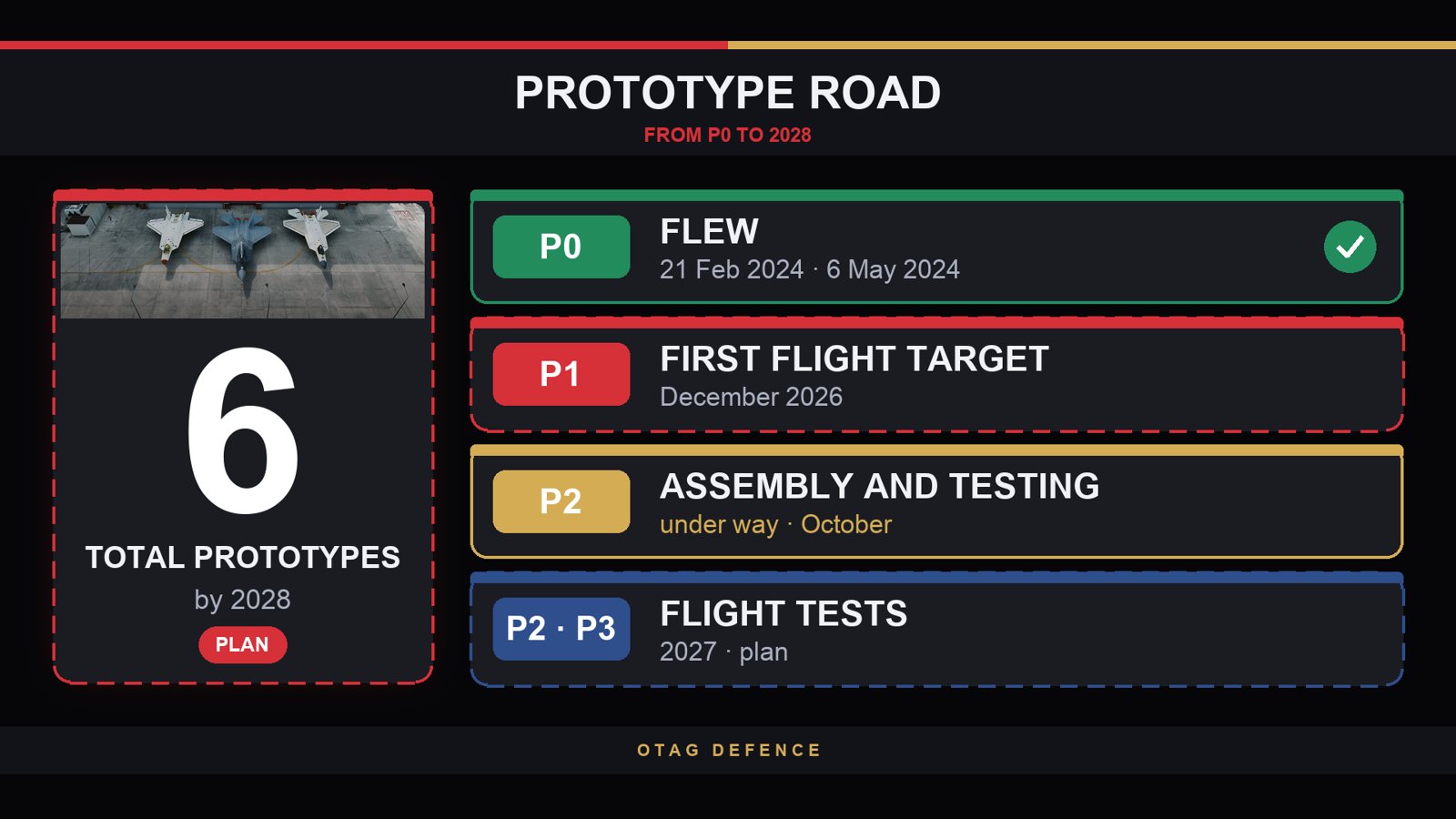
KAAN, Türkiye’s fifth-generation fighter, has a second prototype that could make its first flight in December. Sources tell Otag Defence that Turkish Aerospace is targeting December for P1’s maiden flight and aims to have P2 and P3 ready for flight testing in 2027. The total is expected to reach six prototypes by 2028.
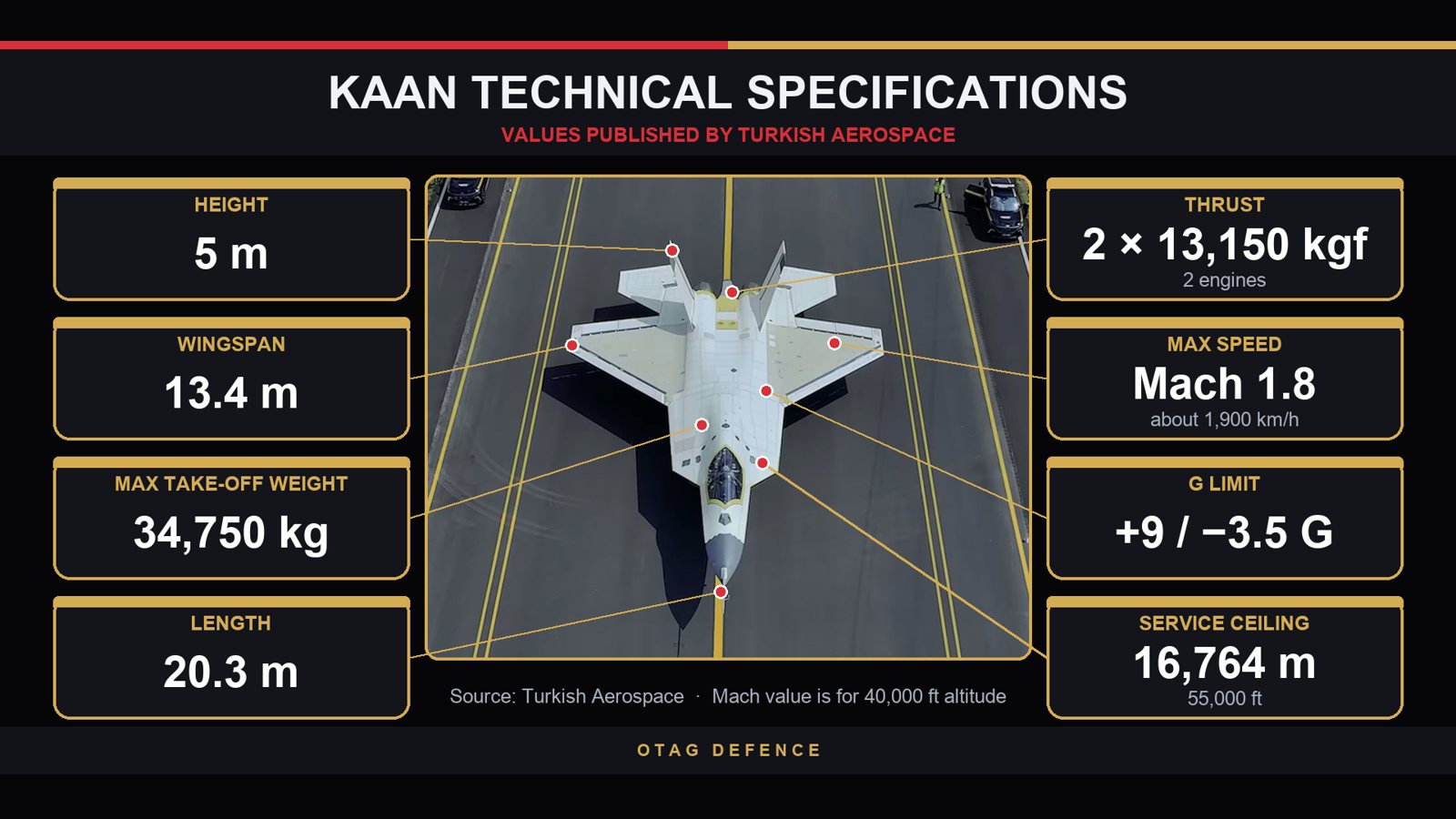
If you are new to this program: KAAN is Türkiye's own fifth-generation fighter. It is a twin-engine stealth jet, designed and built in Türkiye, and it is planned to enter service with the Turkish Air Force. Indonesia has already signed to buy 48. On its official page, Turkish Aerospace lists a length of 20.3 metres, a wingspan of 13.4 metres and a top speed of Mach 1.8, which is roughly 1,900 kilometres per hour. Two engines produce 13,150 kilograms-force of thrust each.
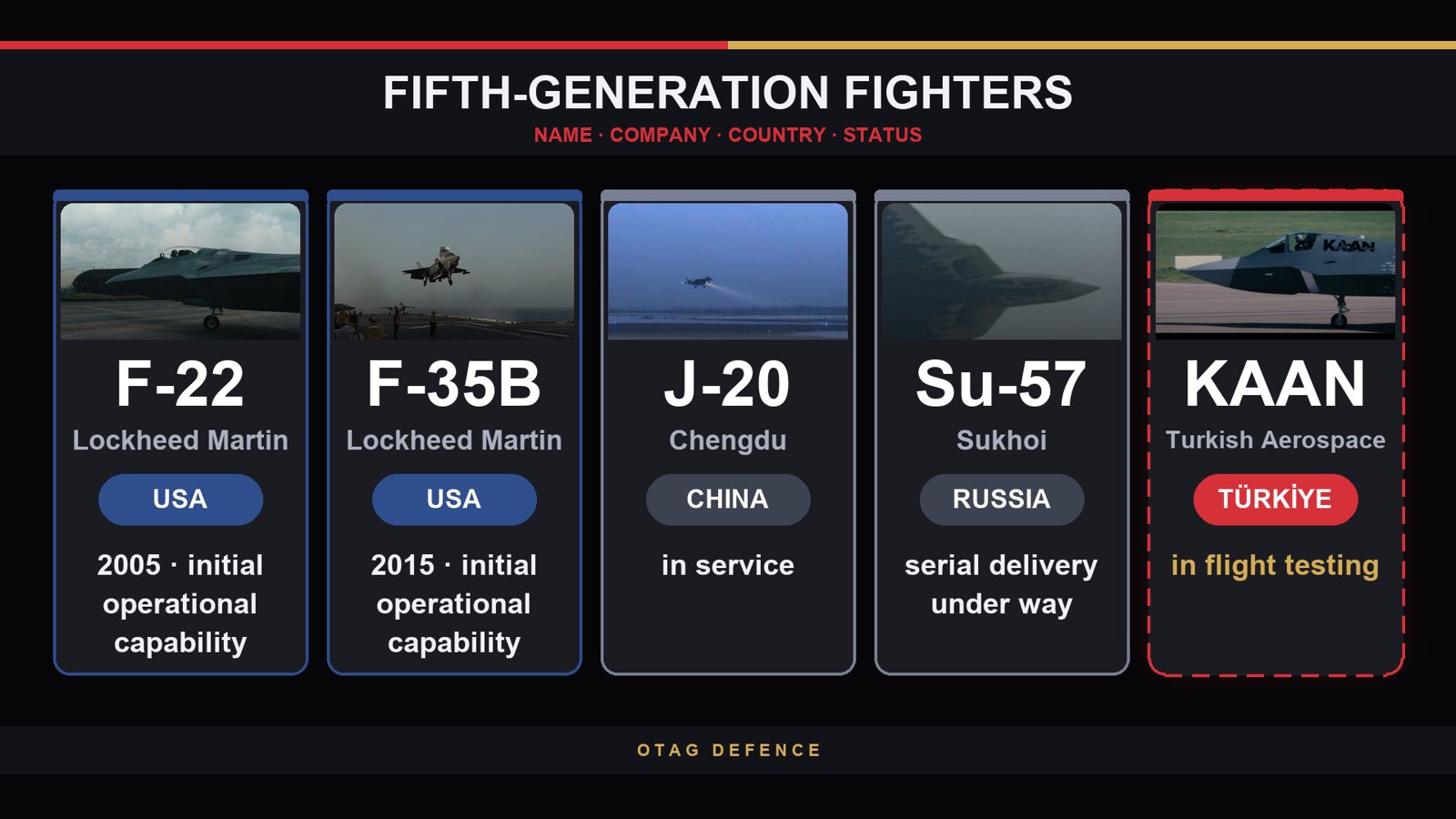
Why does that matter beyond Türkiye? Today the fifth-generation field is small. The United States reached initial operational capability with the F-22 in 2005 and with the F-35B in 2015. China's J-20 is in service, and Russia's Su-57 is in serial delivery. KAAN is still in flight testing. So the question for the next two years is simple: how fast can a program with only one prototype in the air move onto a real production line?
Here is where it stands. The first prototype, P0, took off on 21 February 2024 and made its second flight on 6 May. P1 would be the second KAAN to fly. It was first targeted for May or June. On 2 October, at TEKNOFEST, Türkiye's large aerospace and technology festival, Turkish Aerospace's General Manager said the first flight could happen in October or November if conditions allowed, and that the goal was to fly before the year ends. He added that slow taxi runs and systems tests were complete, that ground tests would follow, and that fast taxi runs would come after that. There is no public announcement yet that fast taxi has been completed. So December remains a target, not a fact.
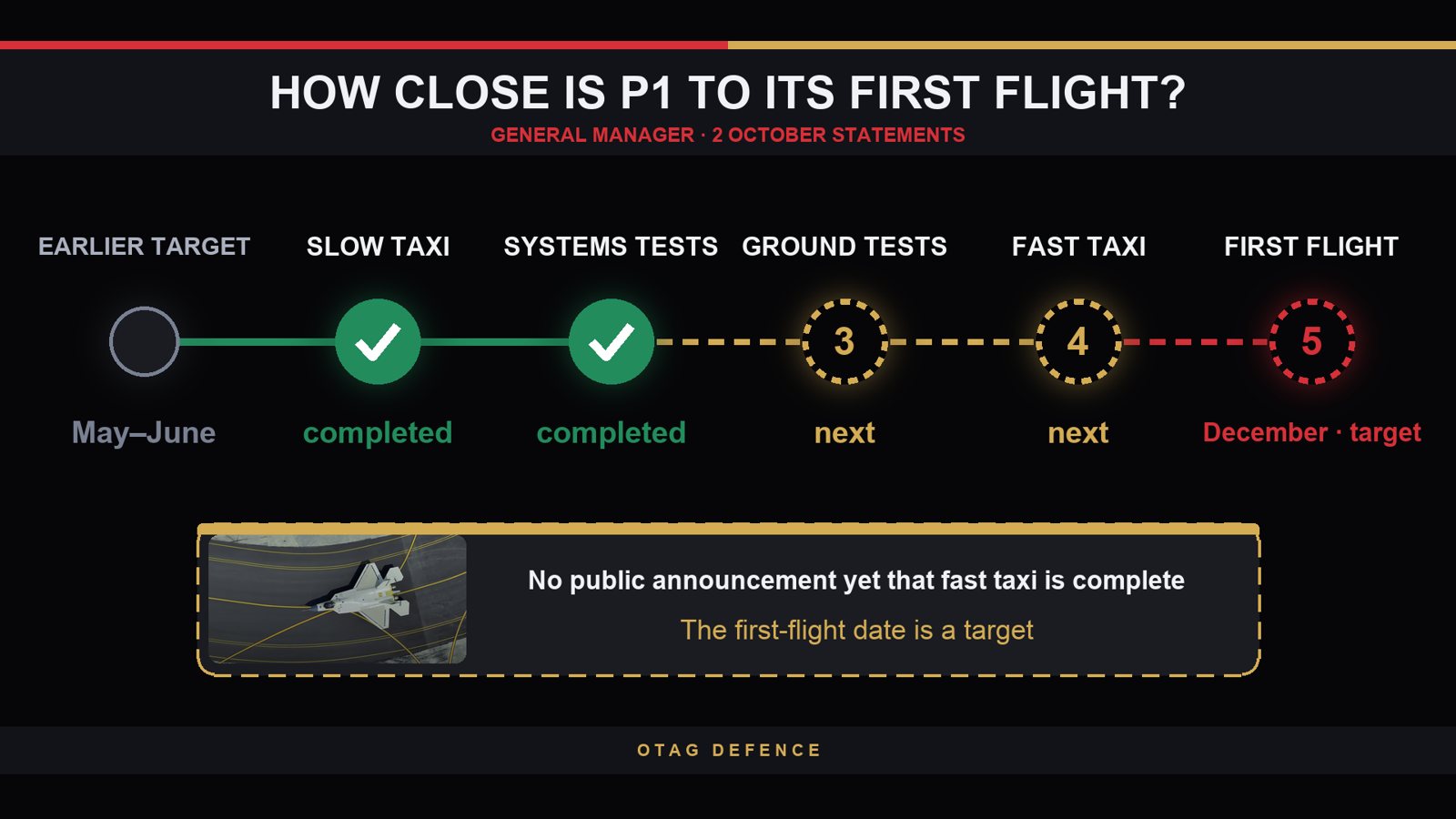
Why is a second flying prototype so important? Because flight testing is slow when one aircraft carries the whole workload. A second aircraft lets engineers split the tests between airframes. The General Manager also said in October that P2 is in assembly and testing. According to Otag Defence's sources, Turkish Aerospace plans to have six prototypes by 2028.
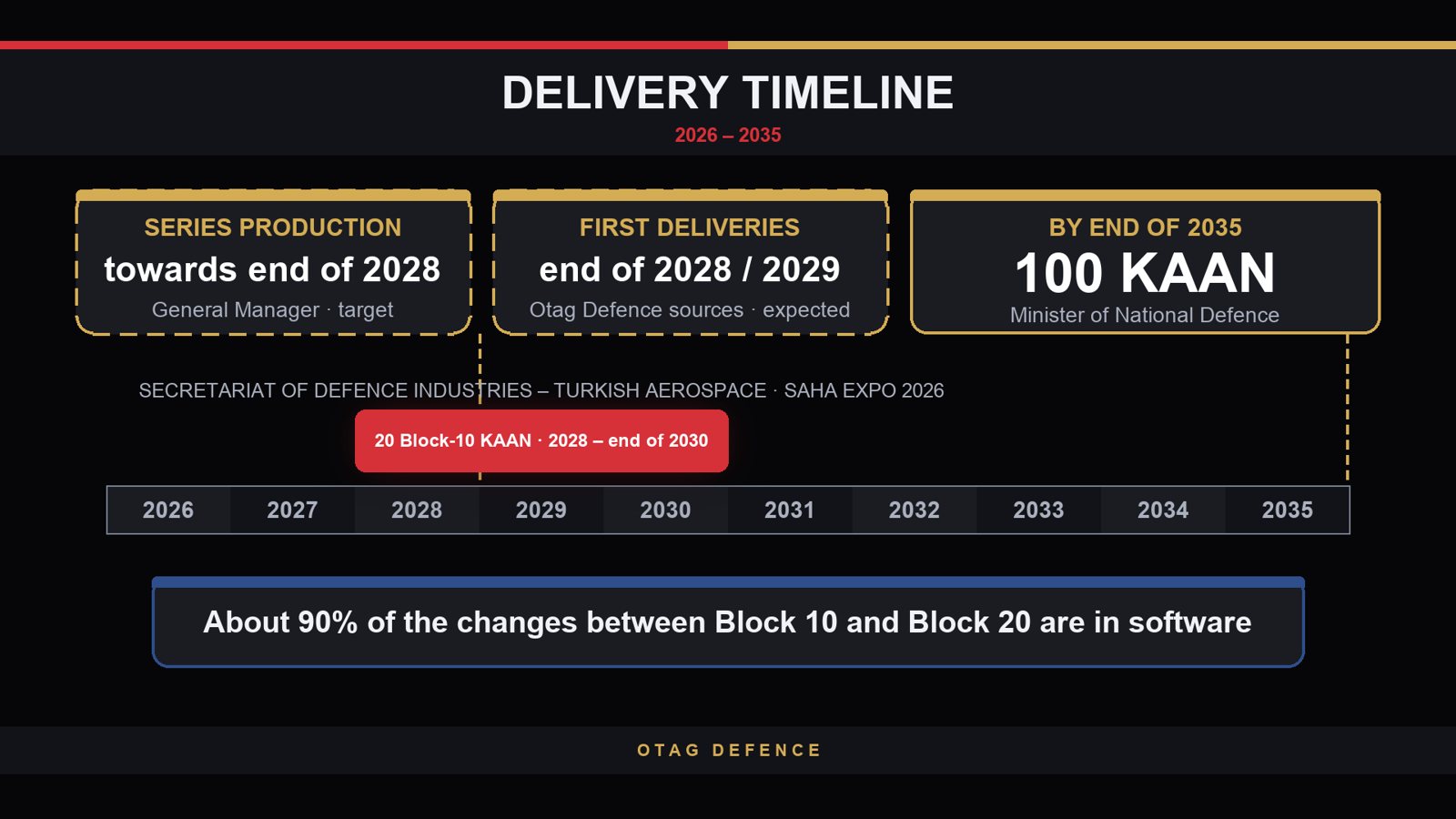
Now the part that matters for customers and allies: delivery. In May, at the SAHA EXPO defence exhibition in Istanbul, the Secretariat of Defence Industries and Turkish Aerospace signed a contract for 20 Block-10 KAAN aircraft. They are to be delivered to the Turkish Air Force from 2028 until the end of 2030. In November, Türkiye's defence minister said the total is expected to reach 100 aircraft by the end of 2035. Turkish Aerospace's General Manager says serial production is planned to start towards the end of 2028, and, according to Otag Defence's sources, the first deliveries are expected at the end of 2028 or in 2029. He also says about 90 percent of the changes between Block 10 and Block 20 will be in software.
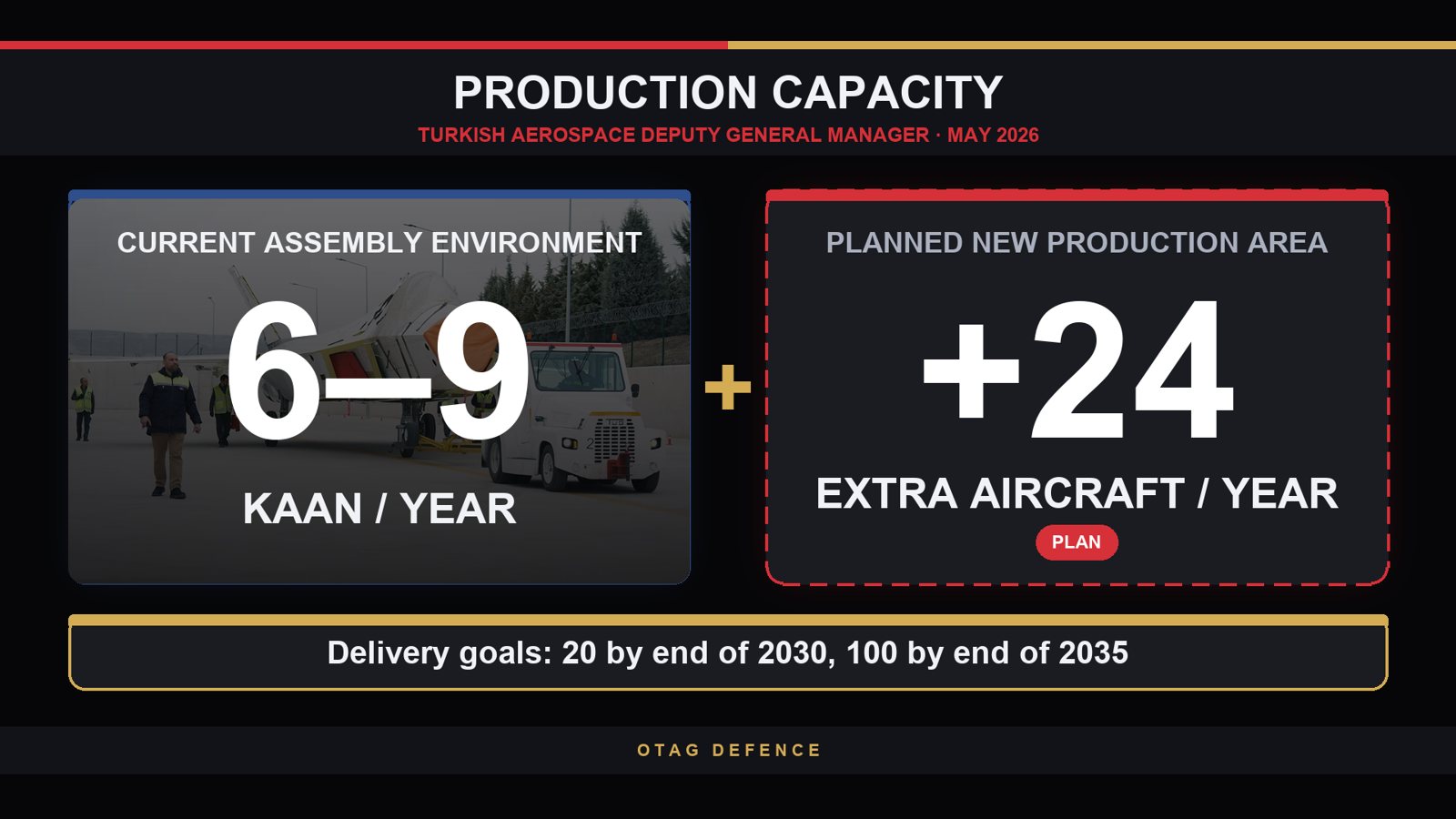
Capacity matters too. Turkish Aerospace's Deputy General Manager said in May that the current assembly environment can build six to nine KAAN a year, and that a new production area for 24 additional aircraft a year is planned.
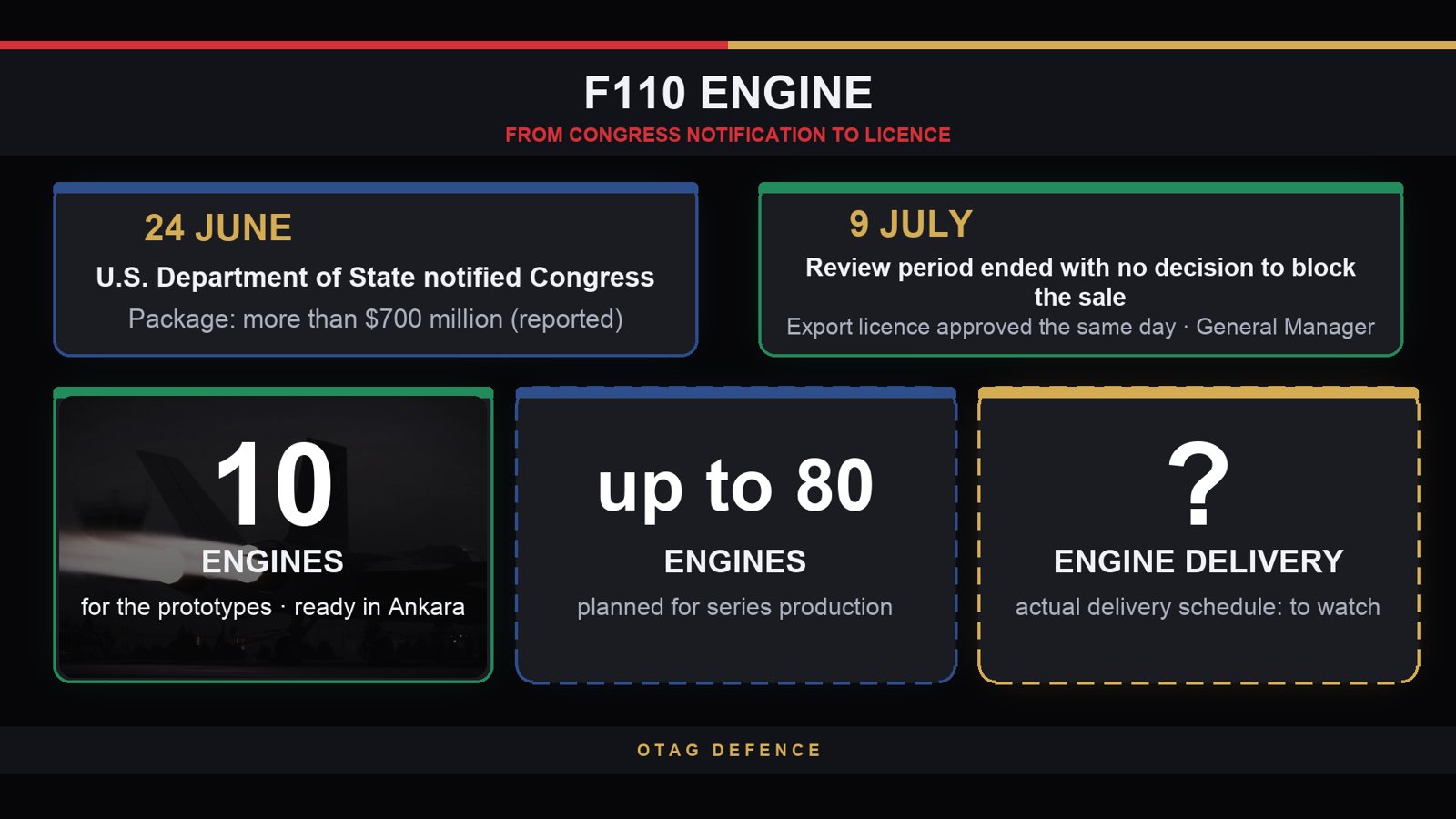
The engine is the key dependency. The first production KAAN jets are planned to use the American-made F110 engine from GE Aerospace. On 24 June, the U.S. Department of State notified Congress of the engine sale. The package was reported to be worth more than 700 million dollars. The 15-day review period ended on 9 July without a decision to block the sale, and Turkish Aerospace's General Manager said the export licence was approved the same day. Ten F110 engines for the prototypes are already in Ankara, and up to 80 engines are planned for series production. So the licence step is done. What matters now is when those engines arrive.
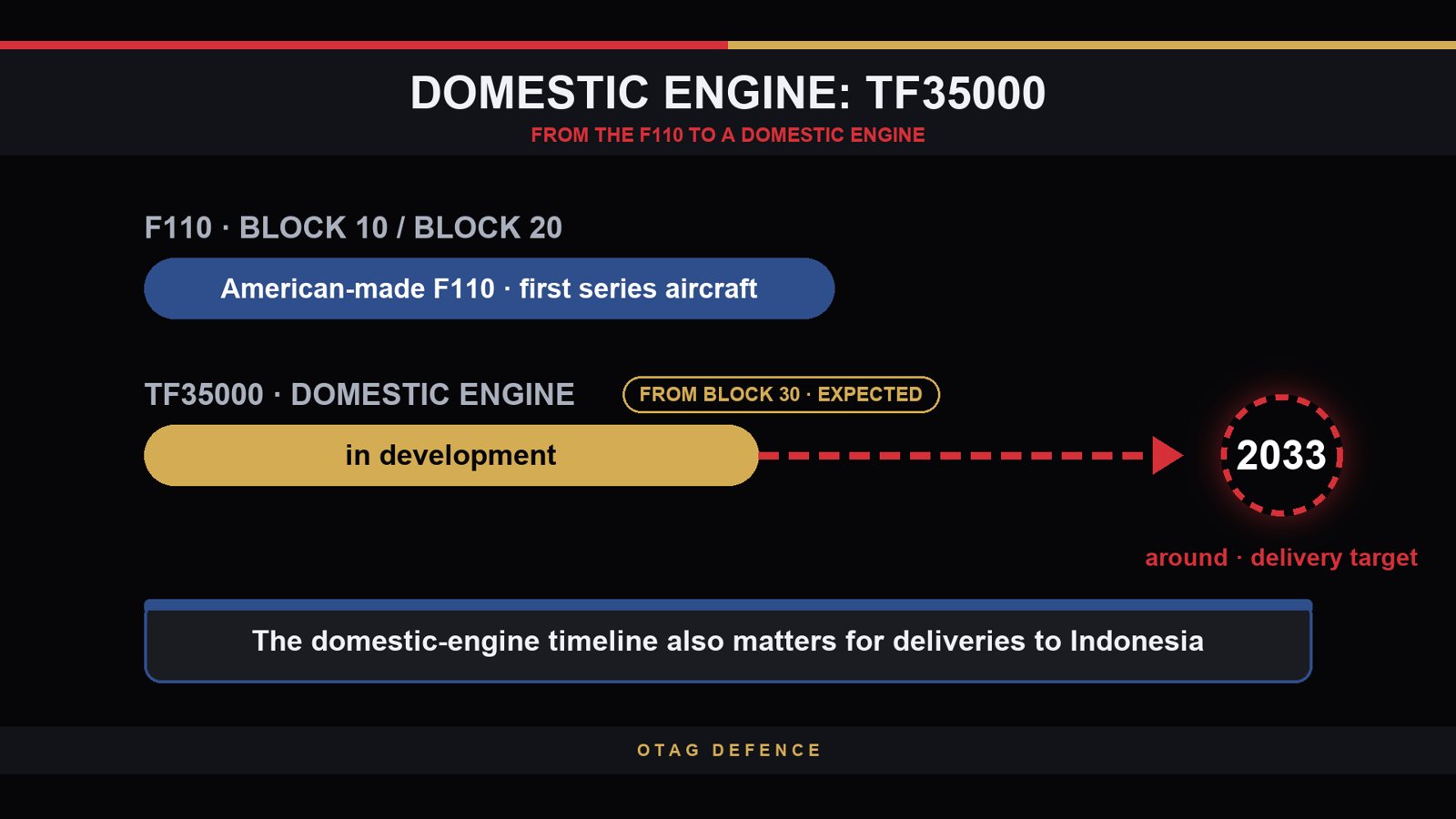
Türkiye's own engine, the TF35000, is still in development. The company aims to start delivering KAAN jets with this engine around 2033, and the domestic-engine version is expected from Block 30. That is the date that will decide how independent KAAN really is. It also matters for exports, because Indonesia's aircraft are planned to be delivered with the domestic engine.
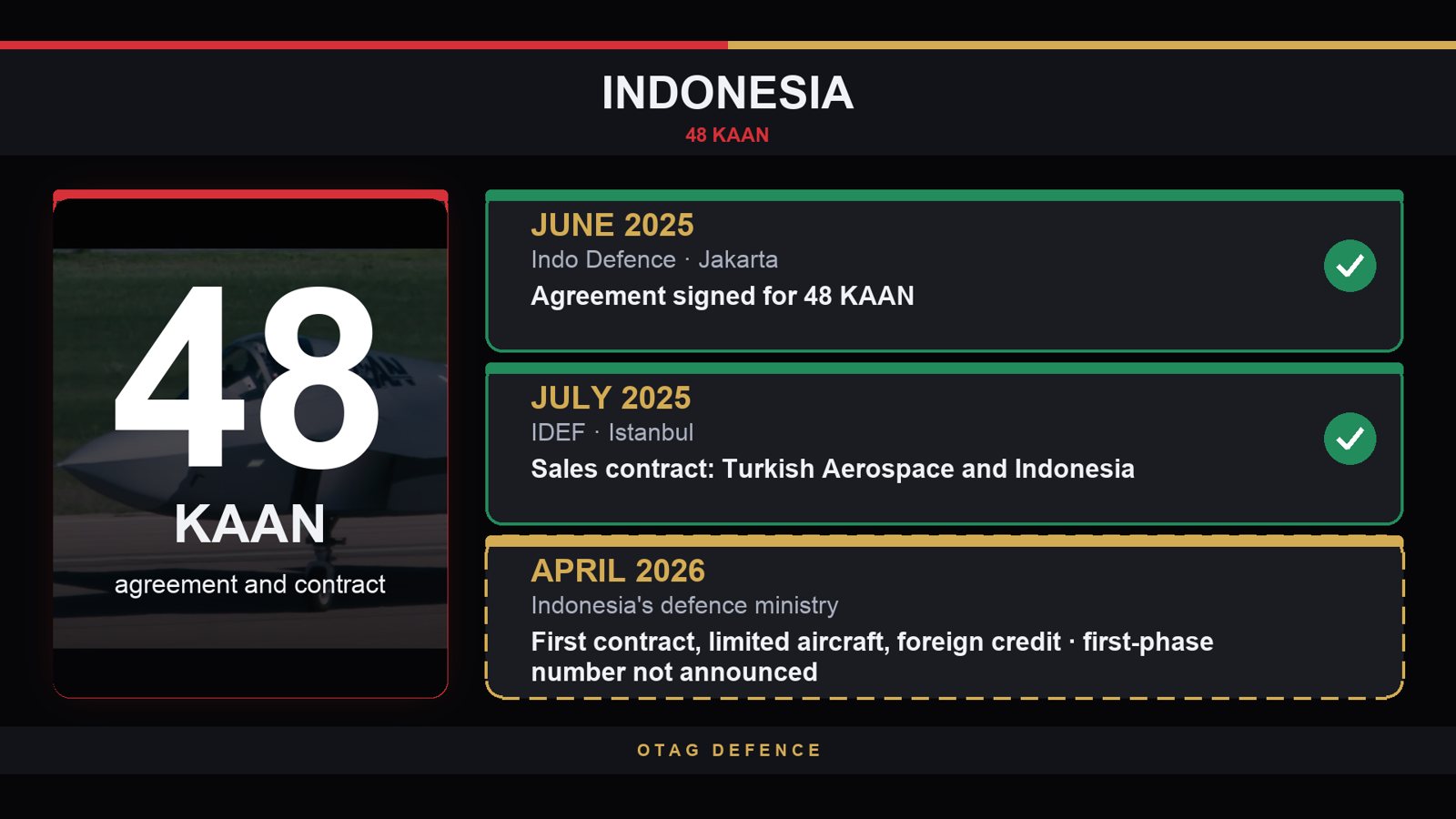
Speaking of exports: Indonesia is the most concrete customer. In June 2025, at the Indo Defence expo in Jakarta, the two countries signed an agreement for 48 KAAN. In July, Turkish Aerospace and Indonesia signed the sales contract at IDEF, the defence exhibition in Istanbul. The deal includes technology transfer and use of Indonesia's manufacturing capabilities. The latest development is financing. In April 2026, Indonesia's defence ministry said it was working to bring the first contract, covering a limited number of aircraft, into force with foreign credit. It has not said how many aircraft will be bought in the first phase.
Pakistan's relationship with the program is older. In 2023, Türkiye's defence minister said an agreement for Pakistan to join the program was close to signature. In the open sources Otag Defence reviewed, there is no announcement that a KAAN-specific partnership agreement has been signed. Two wider agreements put that cooperation in a broader frame. The Mecca Joint Defence Agreement, signed by Saudi Arabia, Pakistan and Türkiye, is a mutual-defence pact. The Badr Memorandum of Understanding, signed by Türkiye, Qatar, Pakistan and Indonesia, covers defence-industry cooperation. Neither is specific to KAAN.
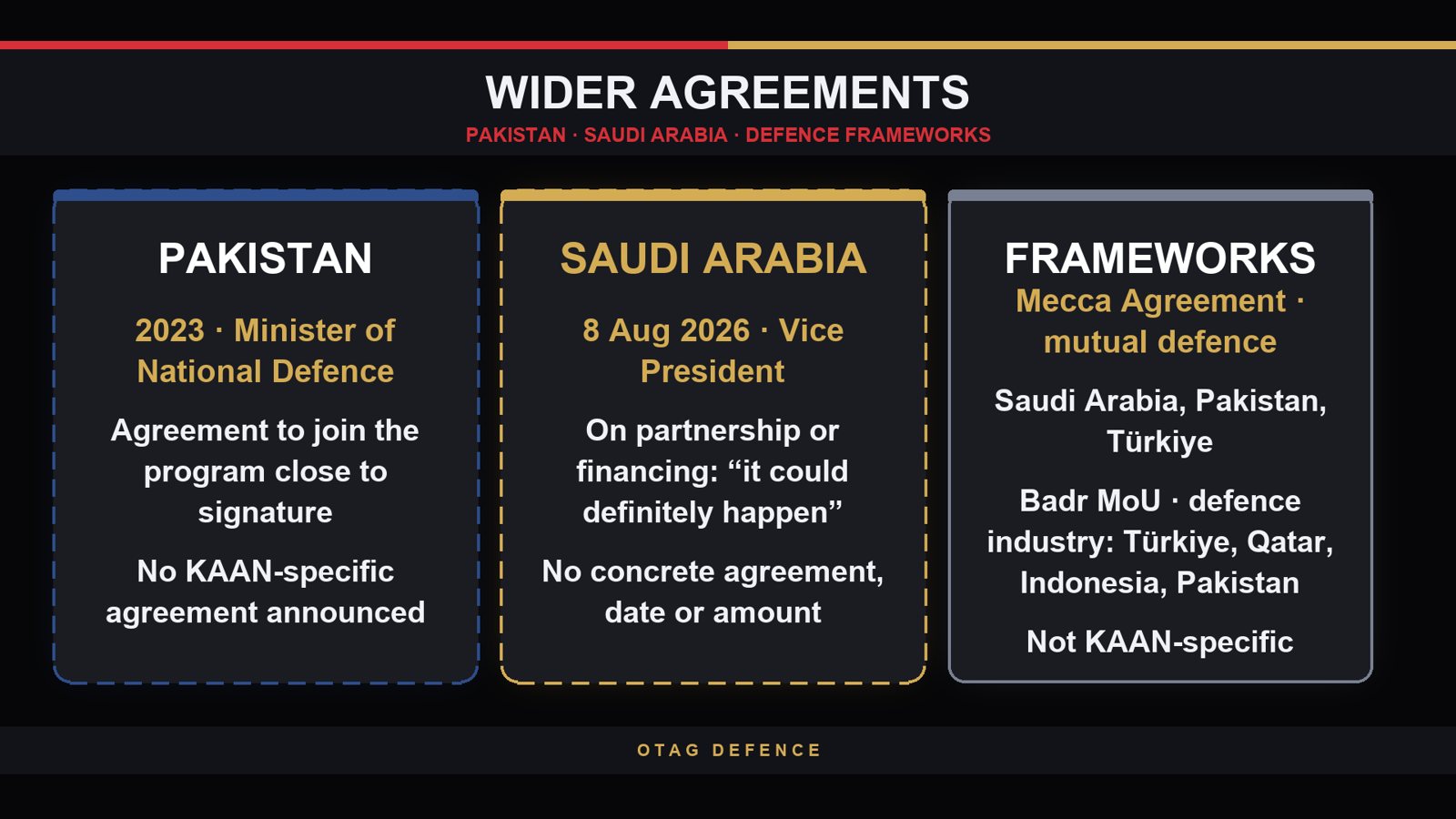
Saudi Arabia has also been mentioned. On 8 August, on the Turkish channel CNN Türk, Türkiye's Vice President was asked whether Saudi Arabia could join KAAN's development with a partnership or financial support. He answered that it could definitely happen. No concrete agreement, date or amount has been announced.
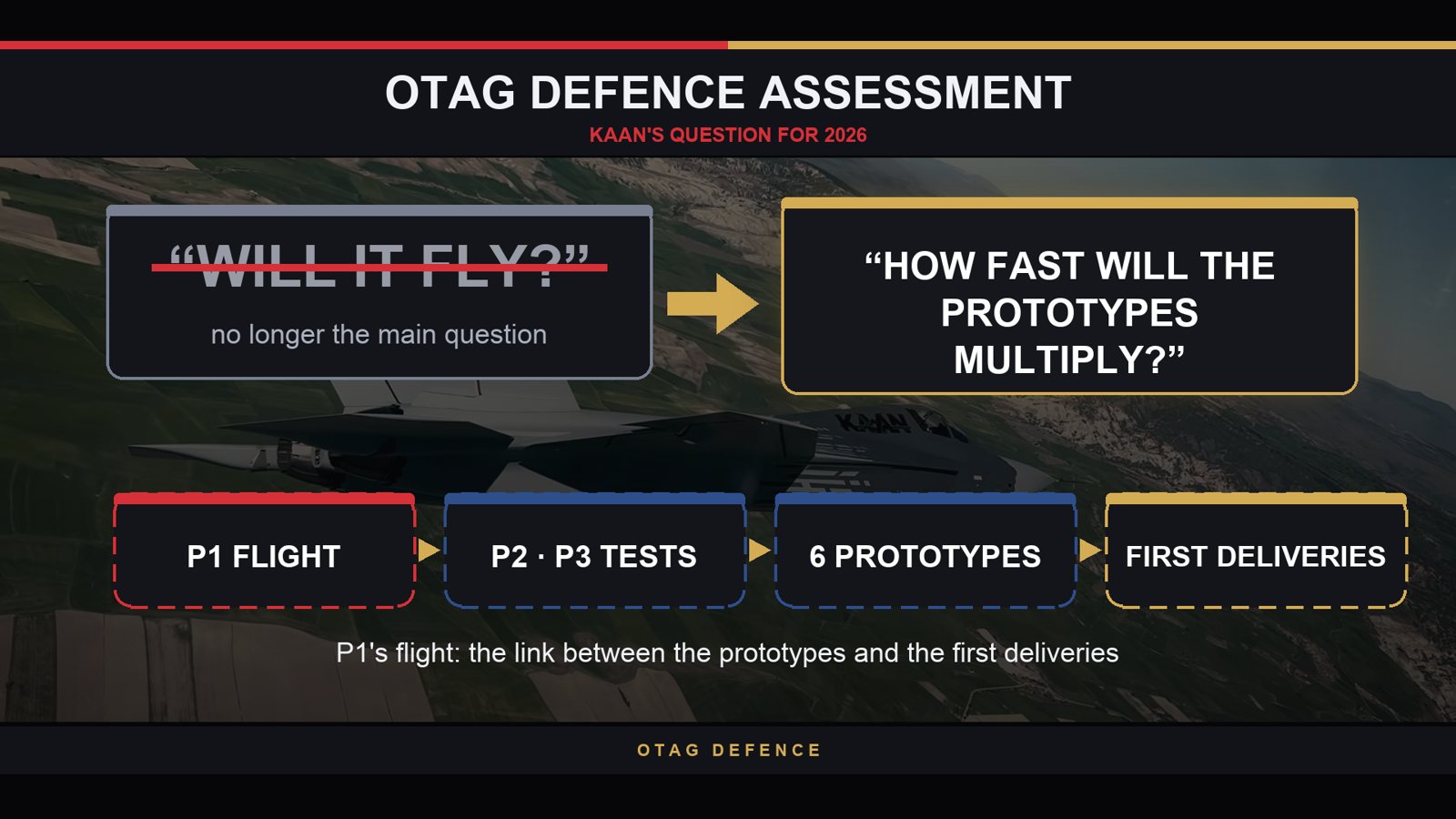
Here is Otag Defence's assessment. For KAAN, the question for 2026 is no longer "will it fly?" It is "how fast will the prototypes multiply?" The flight of P1 is the link that connects P2 and P3 testing, six prototypes and the first deliveries. On the engine side, the licence step is complete, but real independence will come only when the domestic engine is ready.
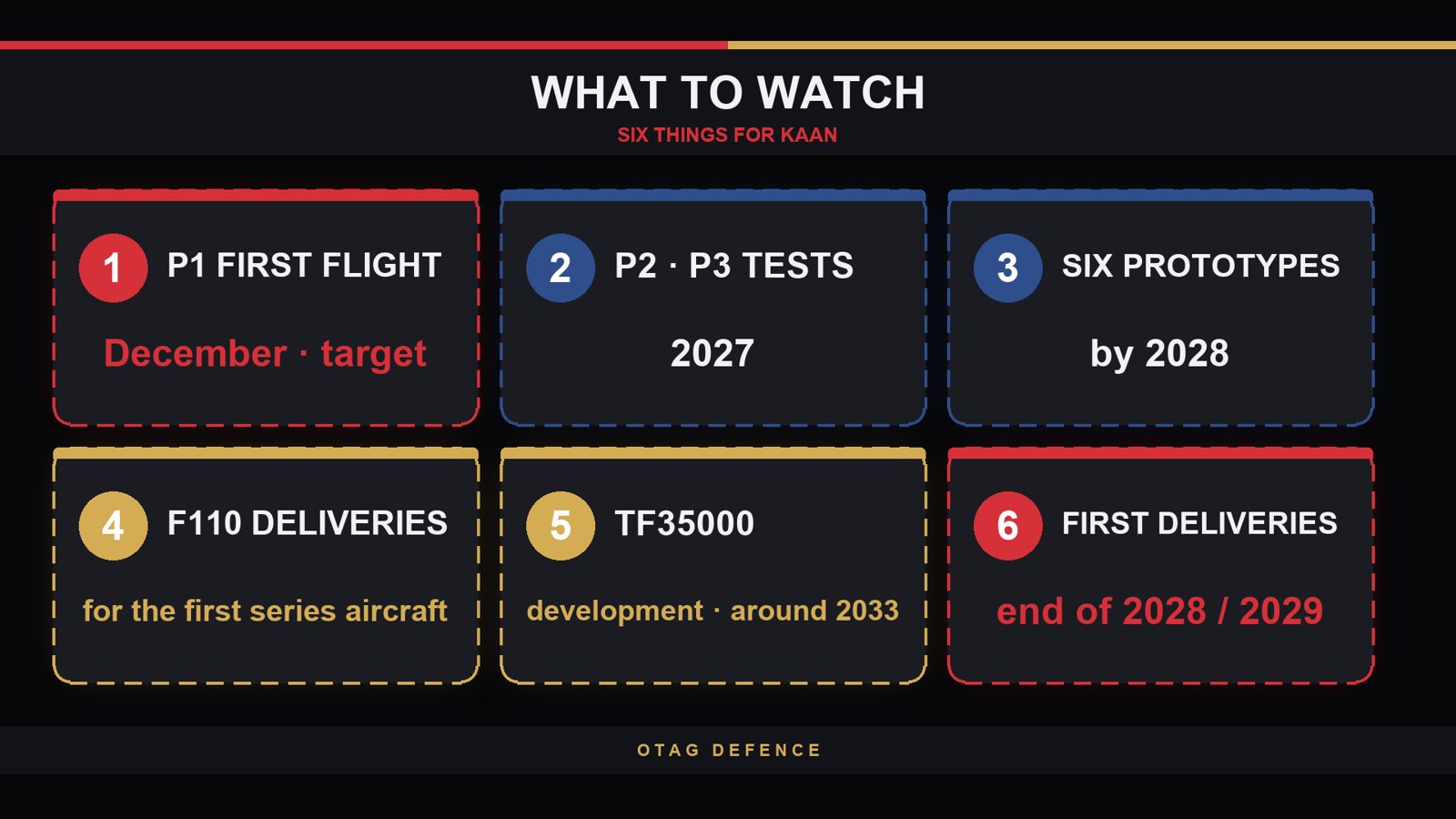
What should you watch? First, P1's first flight in December. After that, how quickly the other prototypes join flight testing, and whether the first deliveries planned for the end of 2028 or 2029 stay on track. We will also follow the F110 deliveries for the first production jets, and the TF35000's development timeline for the domestic-engine version.
So here is our question for you. If you had to bet on one thing, what will decide KAAN's future first: the prototypes, the engine, or the export orders? Share your view in the comments. And don't forget to follow Otag Defence.
Shorts on this topic
Share your view in the comments under the video.
Comment on YouTubeSources
- Anadolu Agency – KAAN speeds up for its next flight (2 October 2026) (in Turkish)
- Haber Aero – KAAN P1 prepares for high-speed taxi before its first flight (in Turkish)
- Haber Aero – Interview with TUSAŞ General Manager Mehmet Demiroğlu (in Turkish)
- Anadolu Agency – The Turkish defence industry's potential on show at SAHA (20 Block-10 KAANs) (in Turkish)
- Haber Aero – Historic contract for KAAN: 20 aircraft to be delivered (in Turkish)
- Sabah – Defence Minister Güler on KAAN deliveries (18 November 2026) (in Turkish)
- Anadolu Agency – New KAAN production area planned for 24 more aircraft a year (in Turkish)
- Haber Aero – US formally notifies Congress of KAAN engine sale (in Turkish)
- Anadolu Agency – 48 KAANs to be built in Türkiye and exported to Indonesia (in Turkish)
- Anadolu Agency – Contract signed for the sale of 48 KAANs to Indonesia (in Turkish)
- ANTARA / VOI – Indonesian Ministry of Defence, foreign loan for KAAN (April 2026)
- TRT Haber – KAAN could be a "golden key" in foreign policy (2023) (in Turkish)
- Milliyet – Partnership talks in the KAAN programme (Vice President Cevdet Yılmaz on CNN Türk) (in Turkish)
- Anadolu Agency – Bedir Memorandum of Understanding signed by Türkiye, Qatar, Indonesia and Pakistan (in Turkish)
- Habertürk – Background on the F-22 (in Turkish)
- Presidency of Defence Industries (SSB) – KAAN completes its second flight (6 May 2024) (in Turkish)
- TUSAŞ – KAAN technical specifications (official page) (in Turkish)
Footage: Turkish Aerospace, Turkish Ministry of National Defence, DVIDS, CCTV.
More analysis
 7:16
The Fastest Military Aircraft: Speed or Stealth?
Why has a half-century-old speed record never been broken? Why are today's fighter jets slower? Speed or stealth?
 12:48
Türkiye's 2035 Target: 1,500 Combat Aircraft
Türkiye is preparing to build more than 1,500 military aircraft over the next 10 years. The target belongs to Turkish Aerospace (TUSAŞ), the country's main state-backed aircraft manufacturer. The company plans to produce more than 1,500 air platforms by 2035. The list includes the KAAN fighter, the HÜRJET jet trainer, the HÜRKUŞ basic trainer, the ANKA 3 unmanned combat aircraft, the AKSUNGUR and ANKA drones, the GÖKBEY utility helicopter and the ATAK attack helicopter. On top of these come more than 10,000 tactical drones and more than 20 satellites. And these figures do not include production by Baykar, Türkiye's other big aircraft maker, of its KIZILELMA, AKINCI, TB2 and TB3 drones. The targets became public through a presentation by Turkish Aerospace General Manager Mehmet Demiroğlu at a panel on subcontracting and supply management. So what do these numbers cover? Which platforms are at which stage? And which technology has Türkiye not yet mastered to reach this scale? That is what we examine in this video.
 11:42
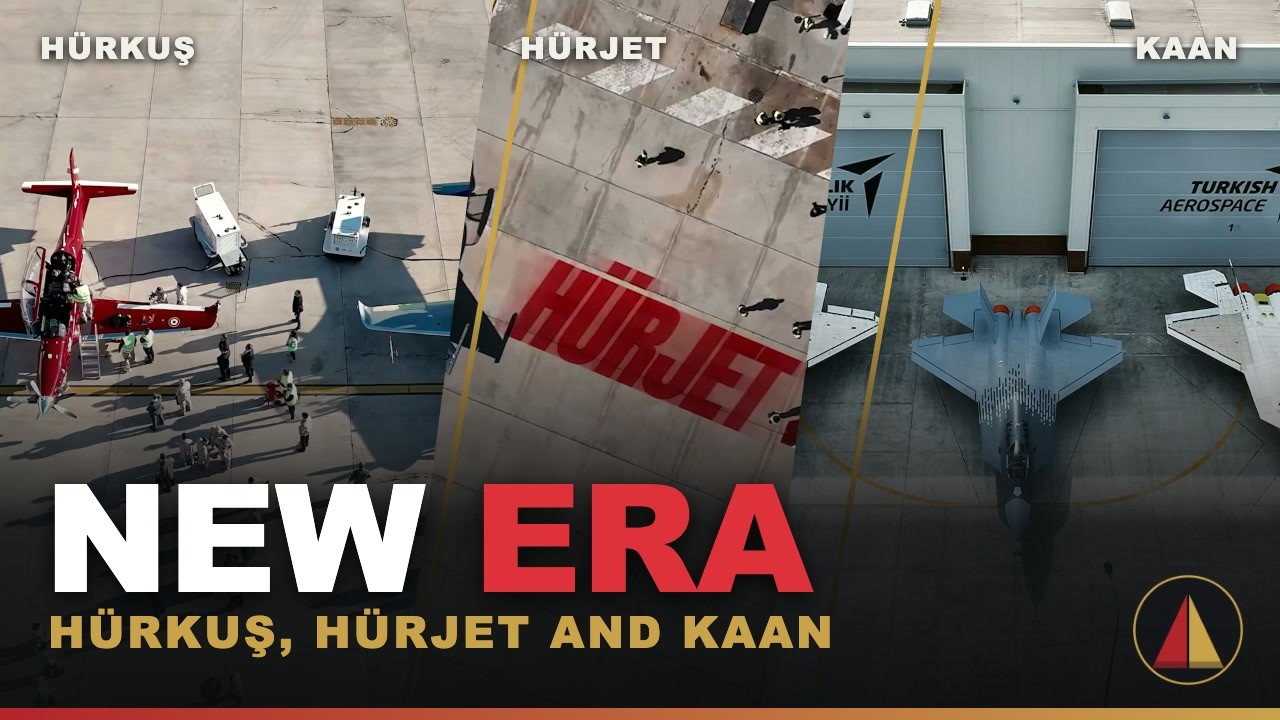
Hurkus, Hurjet and Kaan: A New Era for Turkish Aviation
Türkiye is no longer a country that only flies prototypes. HÜRKUŞ II, a turboprop trainer, has entered service with the Turkish Air Force, and the first export deal has been signed with Azerbaijan. The test fleet of HÜRJET, a jet trainer and light combat aircraft, is growing, and a deal worth about 2.6 billion euros has been signed to export it to Spain. For KAAN, Türkiye's fifth-generation fighter, which already has an export deal with Indonesia, deliveries to the Turkish Armed Forces are targeted from 2028.