Can Türkiye Join the Space Elite? Space League Ranking
Which countries play in the first league of space? Where does Türkiye rank in the world today? And what is the one thing missing to lift Türkiye into the second league?
Which countries are in space's first league? Where does Türkiye rank in the world today? What is the one thing missing that would lift Türkiye into the second league?
Space is a race. But not everyone in this race is in the same league.
Some countries carry people on their own rockets, land on the Moon and send rovers to Mars. Some build their own satellites but depend on someone else's rocket to reach space. Others are still at the starting line.
Where is Türkiye in this picture? Which league is it in today? If its 2027 targets are met, how far up will it climb? And how close is it to the first league?
In this video we draw up the league table of space.
First, let us accept one fact: today there is no official space league ranking that everyone agrees on.
For a time, the American consultancy Futron published a space competitiveness index that sorted countries into four tiers. But that index stopped being published in 2014. The 2025 index of the Belfer Center at Harvard University places Türkiye 21st among 25 countries. But that index measures space together with artificial intelligence, biotechnology, chips and quantum technology.
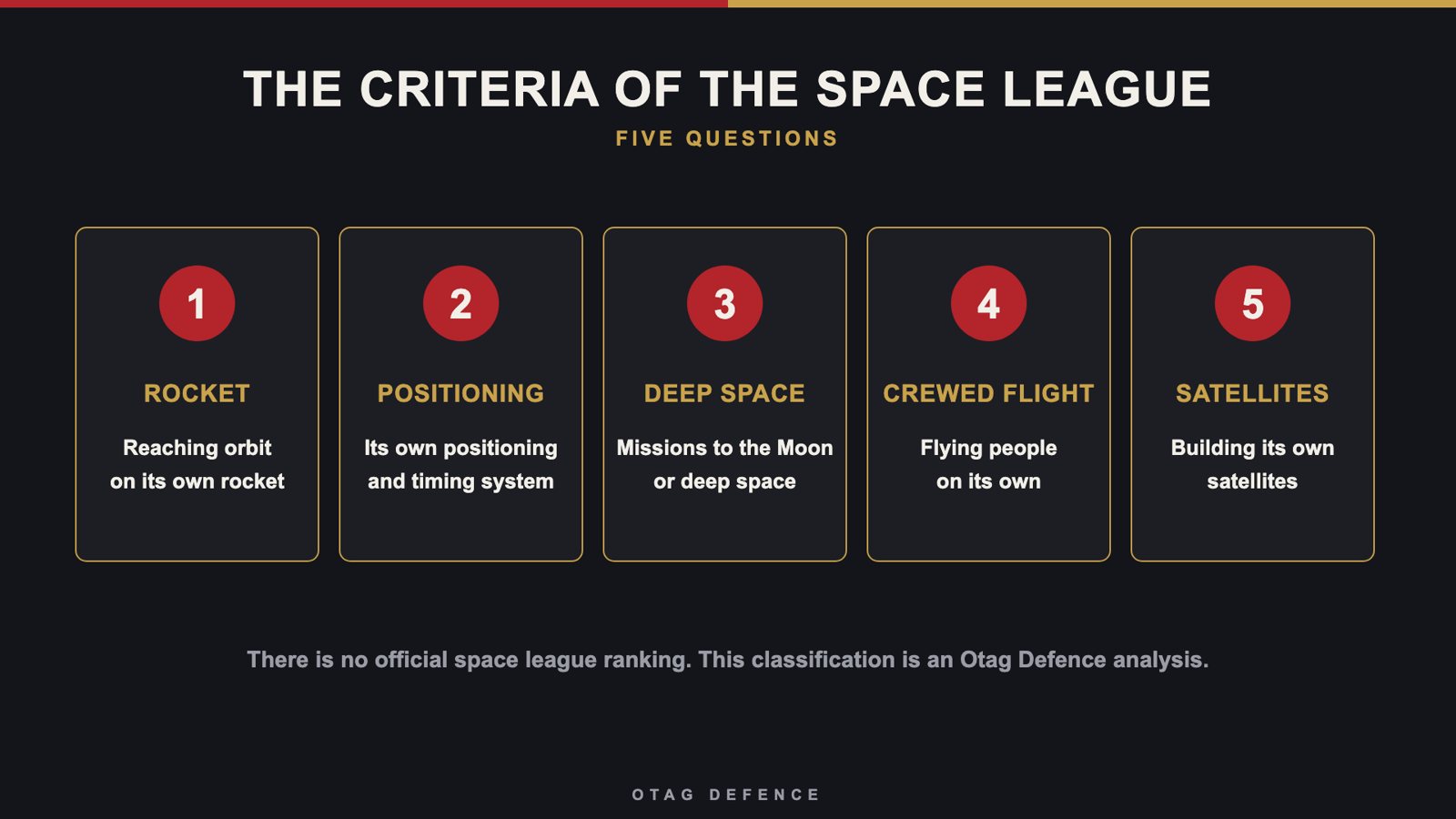
That is why we made a classification with our own criteria. We asked five questions. One: can the country carry a satellite into orbit on its own rocket? Two: does it have its own positioning and timing system? Three: has it sent a spacecraft to the Moon or deep space? Four: can it carry people into space with its own means? Five: can it build its own satellites?
The answers to these questions divide countries into three leagues.
We should also note: this league table is Otag Defence's own analysis and is not based on an official index.
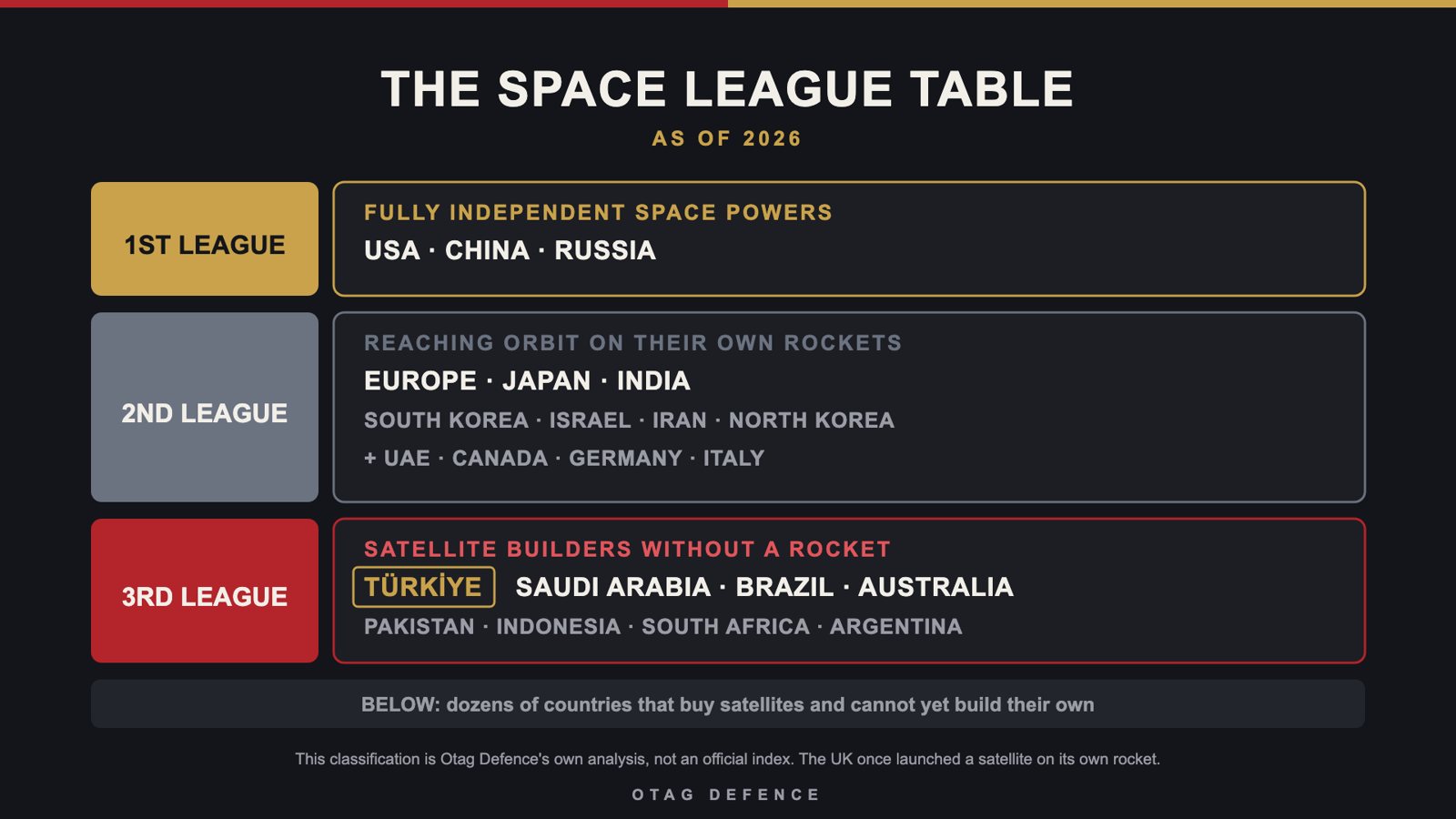
The first league: fully independent space powers.
Only three superpowers are in this league: the United States, China and Russia.
All three can carry people into space on their own rockets. All three have their own global positioning systems. America's GPS is the best known of these. Russia and China have also built their own global systems. All three send regular missions to the Moon and deep space.
The United States is far ahead in the number of launches. China has built its own space station and landed a rover on the far side of the Moon. Russia, with its Soviet legacy, is still one of the key players in human spaceflight.
What keeps these three powers in the first league is that they depend on no one for access to space or for carrying people into space.
The second league: countries that can reach orbit on their own rockets.
At the top of this league are Europe, Japan and India.
Europe, under its joint space agency, has its own rockets and a global positioning system called Galileo. Japan made a precision landing on the Moon and brought back samples from an asteroid. India became the first country to make a soft landing near the Moon's south pole.
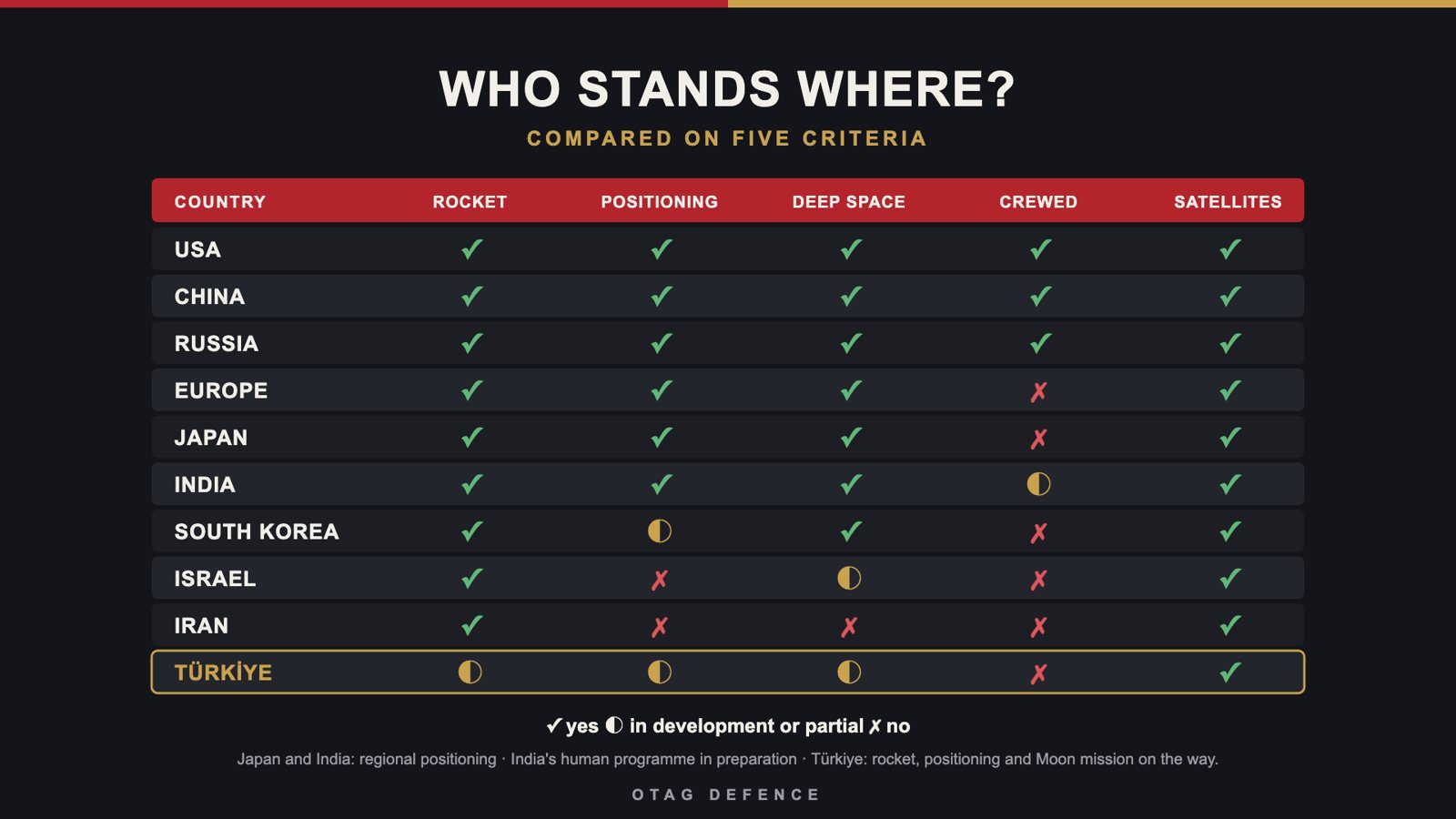
But all three share one gap: none of them can yet carry people into space with its own means. India is preparing its own human spaceflight program and is the closest candidate for the first league.
This league also includes South Korea, Israel, Iran and North Korea. What these countries have in common is that they can put their own satellites into orbit on their own rockets. The United Kingdom has also launched a satellite on its own rocket in the past.
In recent years South Korea has reached orbit on its own rocket and sent a spacecraft into lunar orbit. Israel has a small but highly advanced satellite industry.
The second league also includes countries that have strong space capabilities even without their own rocket. The United Arab Emirates sent a spacecraft into orbit around Mars. Canada is a world leader in space robotics. Germany and Italy are the strongest partners in the European program.
The third league: countries that build satellites but cannot reach space on their own rocket.
This league includes countries such as Türkiye, Saudi Arabia, Brazil, Australia, Pakistan, Indonesia, South Africa and Argentina.
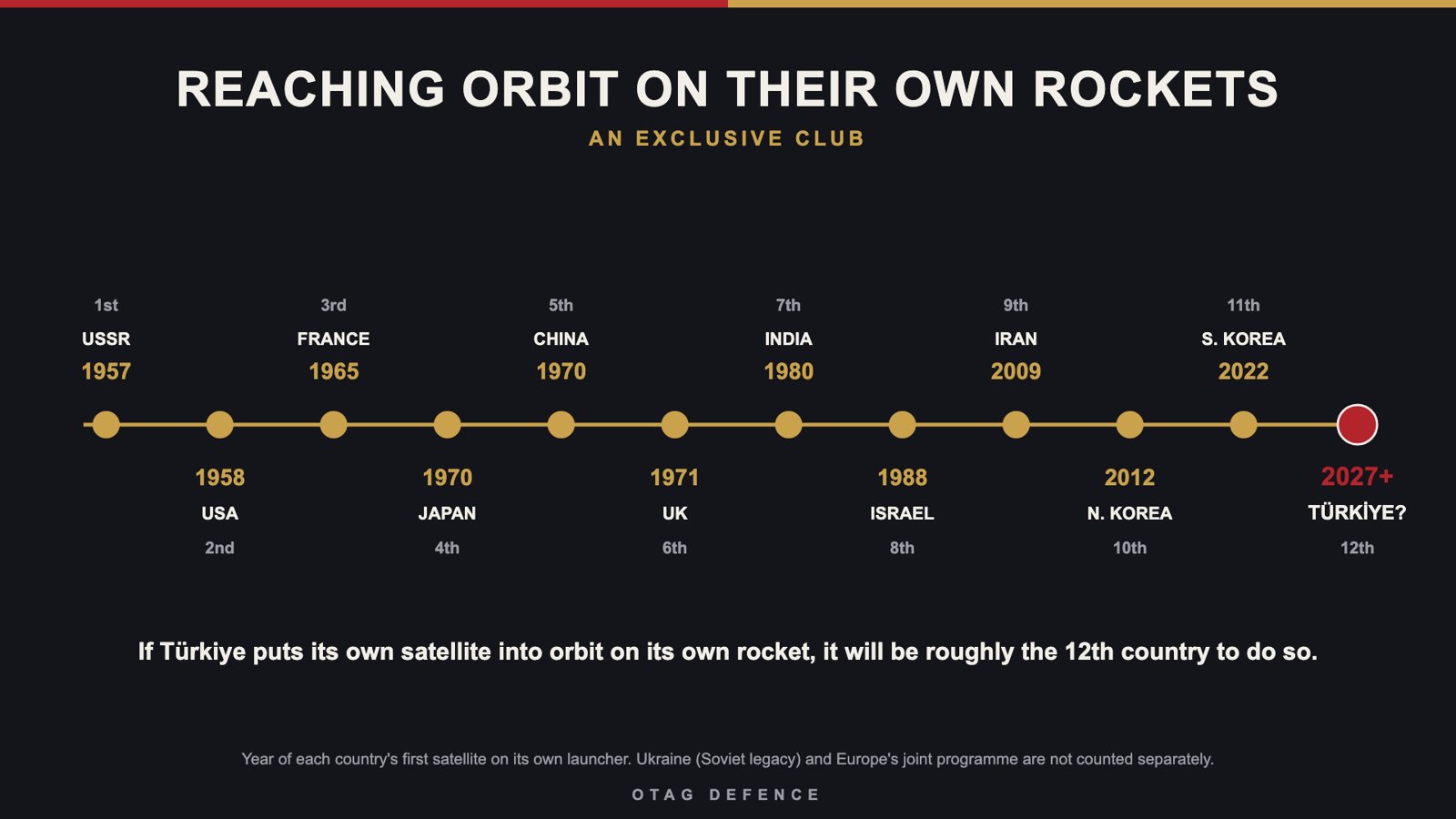
Most of these countries use satellites, and some of them build satellites. But all of them depend on other countries' rockets and schedules to reach space.
The price of this dependence can be heavy. A country's satellite can wait months for a launch slot. When a political crisis breaks out, launch services can be suspended. A military observation satellite may have to be loaded onto another country's rocket, at another country's base.
Some countries in the third league have serious budgets. Saudi Arabia is investing heavily in space, Australia has set up its own space agency, and Brazil has a launch site close to the equator. But none of them has yet achieved regular access to orbit on its own rocket.
Below these three leagues are dozens of countries that buy and use satellites but cannot yet build their own. Türkiye left this line behind long ago.
But there is only one key to moving up a league: reaching space with your own means.
So where is Türkiye in this league?
Our answer is clear: Türkiye is at the top of the third league and at the door of the second.
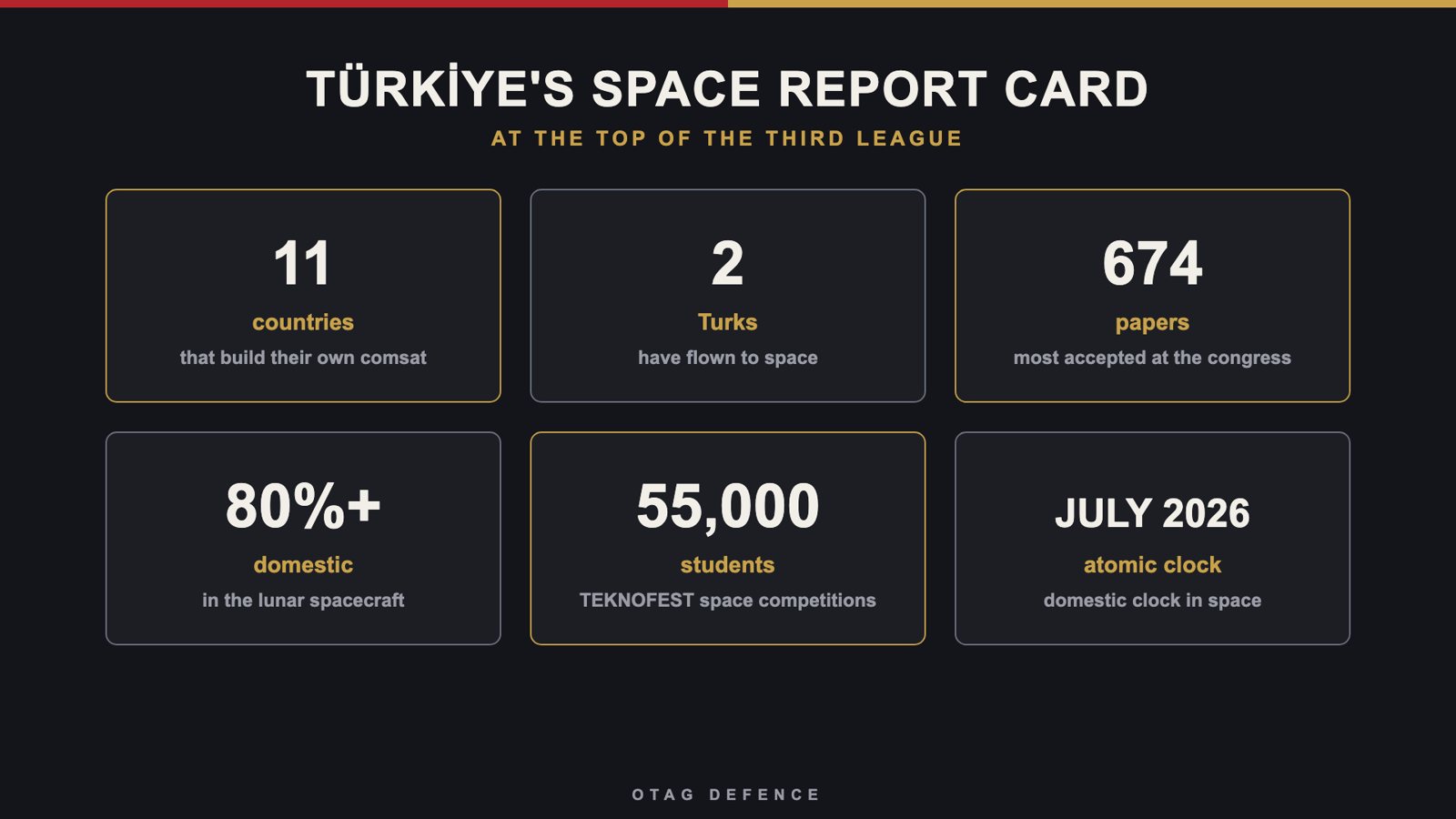
Why? Because Türkiye has capabilities that most of its rivals in the third league do not.
With TÜRKSAT 6A, Türkiye became one of 11 countries in the world able to build its own communications satellite. With İMECE, it built a domestic observation satellite with sub-metre resolution.
Two Turkish citizens have gone to space. Alper Gezeravcı carried out scientific experiments on the International Space Station.
The private sector is building its own satellite networks in low Earth orbit. Fergani, Plan-S and ASELSAN, Türkiye's largest defence electronics company, are running constellation projects of hundreds of satellites.
In July 2026, a domestic atomic clock was sent into space.
And Türkiye has made its mark in science. At the International Astronautical Congress in Antalya, Türkiye was the country with the most accepted papers, with 674.
Let us also make a regional comparison.
Around Türkiye, two countries can reach orbit on their own rockets: Israel and Iran. Both built this capability on top of missile programs that lasted decades.
Türkiye's situation is similar. The experience of ROKETSAN, Türkiye's main missile maker, in missile technologies forms the basis of the rocket that will take it to space. The difference is this: Türkiye is combining this capability with a strong satellite industry, human spaceflight experience and a dynamic private sector.
The Gulf countries, meanwhile, are investing in space with large budgets but largely buy their technology from abroad. Türkiye's difference is domestic production. More than 80 percent of its lunar spacecraft is domestic.
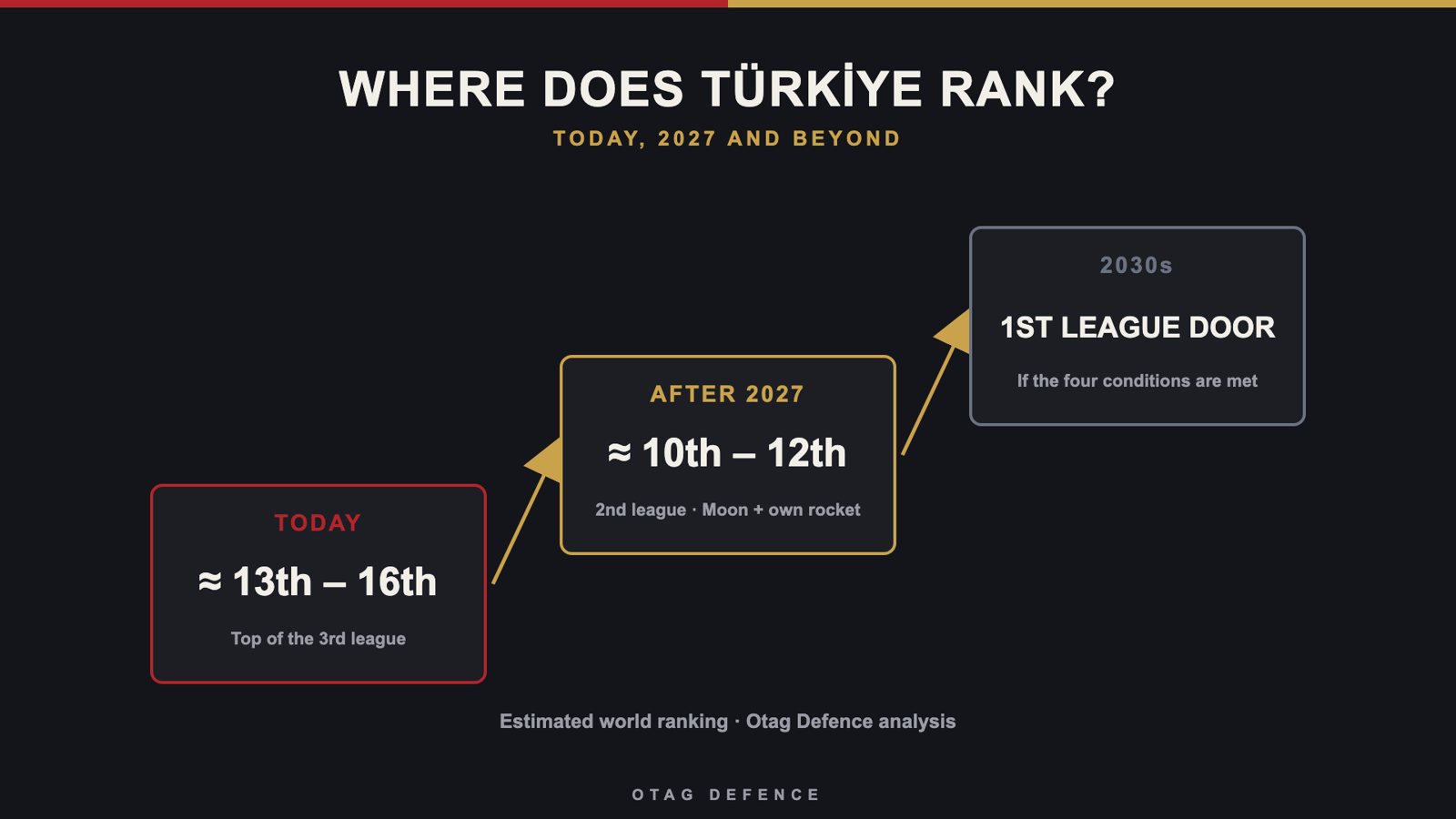
Taking all of this together, we can say that Türkiye is today somewhere between roughly 13th and 16th place in the world.
But one gap keeps Türkiye in the third league: it cannot reach space on its own rocket.
In 2027 this picture may change. There are three critical developments.
The first is the Moon mission. Türkiye's first lunar spacecraft will be launched in the first half of 2027, operate in lunar orbit and make a hard landing on the Moon's surface at the end of the mission. Very few countries have been able to get a spacecraft to the Moon's surface. This mission will give Türkiye deep-space prestige. But it has one gap: the spacecraft will leave Earth on a foreign rocket. That is why the Moon mission alone will not take Türkiye into the second league.
The second is the Somalia Spaceport. According to a statement by Yusuf Kıraç, President of the Turkish Space Agency, to the Otag Defence team, the spaceport, which will enter service in 2027, will give Türkiye its own launch site close to the equator and open to the ocean.
The third and most important is a domestic rocket. The goal is to put a domestic satellite into orbit on ROKETSAN's Şimşek-1 rocket at the end of 2027. Turkish Aerospace (TUSAŞ), meanwhile, gives a window of 2028 to 2029 for this launch.
This is the real threshold. When Türkiye puts its own satellite into orbit on its own rocket, it will be roughly the 12th country in the world to do so. And it will move up to the second league.
So where will Türkiye rank at the end of 2027?
If the Moon mission succeeds and the first satellite reaches orbit on a domestic rocket, Türkiye will settle between 10th and 12th place in the world. That means entering the same league as South Korea and Israel.
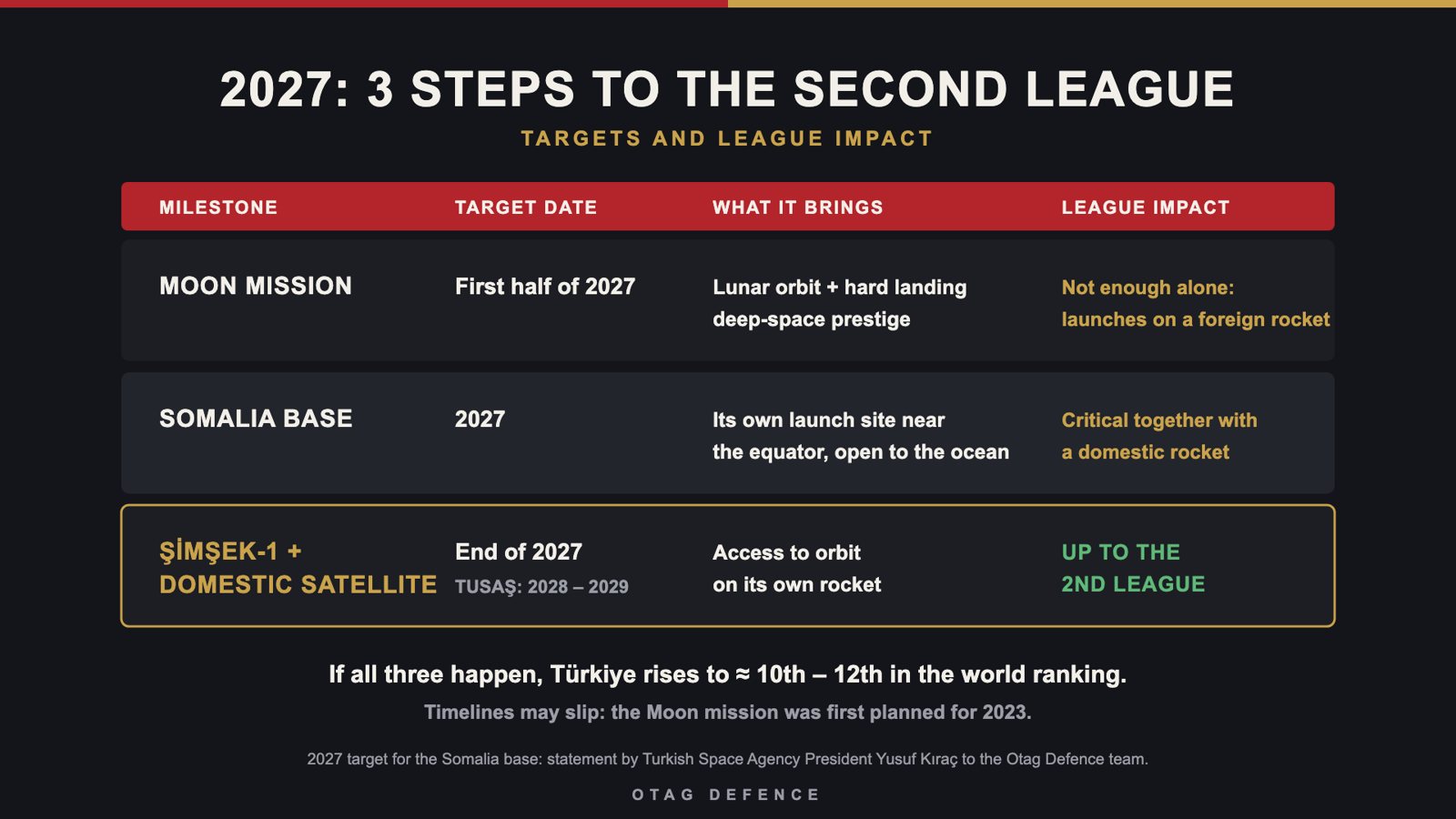
But this scenario has one condition: the schedules must hold. The Moon mission was first planned for 2023. The domestic rocket target has also been postponed several times. It would not be surprising if the dates slipped by a few months or a year.
And the big question: how close is Türkiye to the first league?
The honest answer: still far. But the roadmap is clear.
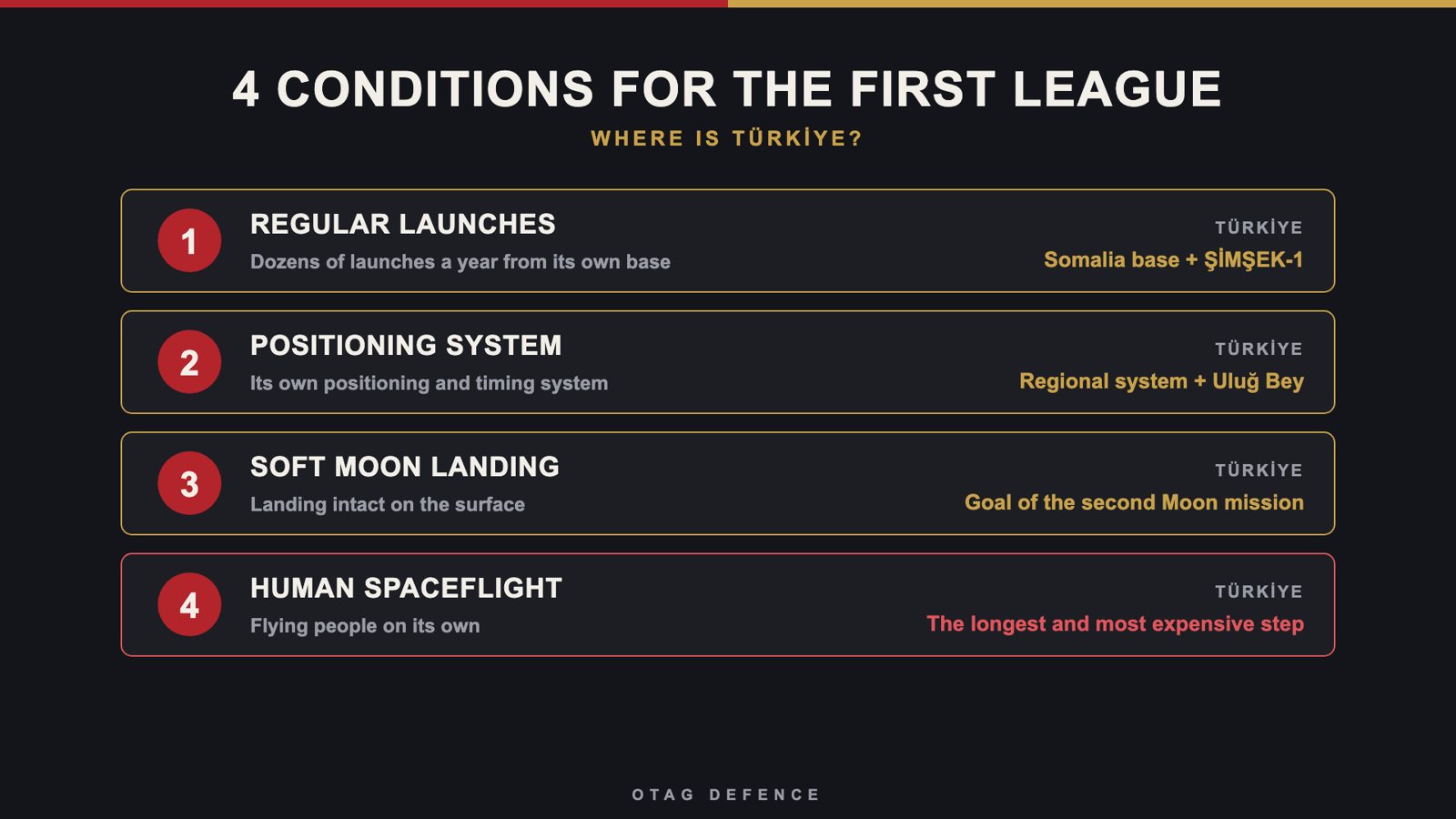
To reach the first league, a country must achieve four things.
One: launch heavy payloads regularly from its own base. Not a few launches a year, but dozens.
Two: put its own positioning and timing system into service. Türkiye's regional positioning system and Fergani's Uluğ Bey project are on this path.
Three: make a soft landing on the Moon. Türkiye's second Moon mission aims to do exactly that.
Four: carry people into space with its own means. This is the longest and most expensive step.
Even if all of the 2027 targets are met, Türkiye will be in the second league, not the first. But if regular launches begin from Somalia, the positioning system enters service, hundreds of Turkish satellites circle in low Earth orbit and the second Moon mission lands on the surface, then in the 2030s Türkiye will be among the countries knocking on the door of the first league.
One last note. The space league is won not only with rockets but with people.
The record number of papers at the International Astronautical Congress and the 55,000 students who applied to the space competitions at TEKNOFEST, Türkiye's large technology festival, show that Türkiye is preparing to stay in this league.
A high-school student designing a vertical-landing rocket today could be the engineer of a rocket launched from Somalia in the 2030s.
Do you think Türkiye can move up to the second league in 2027? When will it reach the first league? Share your views in the comments.
Don't forget to follow Otag Defence.
Shorts on this topic

How close is Türkiye to the space superpowers?

11 countries reach orbit on their own rockets. Why not Türkiye?

Where does Türkiye rank in space?
Share your view in the comments under the video.
Comment on YouTubeSources
- SpaceNews – Futron Corporation Releases Fourth Annual Space Competitiveness Index
- Harvard Belfer Center – Critical and Emerging Technologies Index
- USA – GPS.gov
- China National Space Administration (CNSA)
- European Space Agency – What is Galileo?
- JAXA – SLIM lunar landing
- JAXA – Hayabusa2 asteroid sample return
- Indian Space Research Organisation (ISRO) – Chandrayaan-3
- Korea Aerospace Research Institute (KARI)
- Emirates Mars Mission
- UK Space Agency
- Anadolu Agency (in Turkish)
- Anadolu Agency (in Turkish)
- CNN Türk (in Turkish)
- Anadolu Agency (in Turkish)
- TÜBİTAK (in Turkish)
- Turkish Space Agency (in Turkish)
- Baykar – Fergani (in Turkish)
- Anadolu Agency (in Turkish)
- Anadolu Agency (in Turkish)
- Anadolu Agency (in Turkish)
- TRT Haber (in Turkish)
- TEKNOFEST (in Turkish)
- Satellite Markets – Futron 2014 Space Competitiveness Index (last edition; the index ended after 2014)
- Belfer Center – Critical and Emerging Technologies Index report (PDF)
- Anadolu Agency (in Turkish)
- Oshratsl · CC BY-SA 4.0 ·
- NASA Kennedy Space Center / NASA/Ben Sme · Public domain ·
- NASA Johnson Space Center / Sultan Alney · Public domain ·
- Agência Brasil · CC BY 3.0 ·
- Ideophagous · CC BY-SA 4.0 ·
- Latitude · CC BY-SA 4.0 ·
- NASA Johnson Space Center · Public domain ·
- NASA Johnson Space Center · Public domain ·
- CONAE · CC BY 2.5 ar ·
- Casa Rosada · CC BY 2.5 ar ·
- Casa Rosada · CC BY 2.5 ar ·
- Bill Ingalls · Public domain ·
- Shinntarou · CC BY-SA 4.0 ·
- NASA · Public domain ·
- NASA Earth Science and Remote Sensing Unit · Public domain ·
- NASA Earth Science and Remote Sensing Unit · Public domain ·
More analysis
 8:32
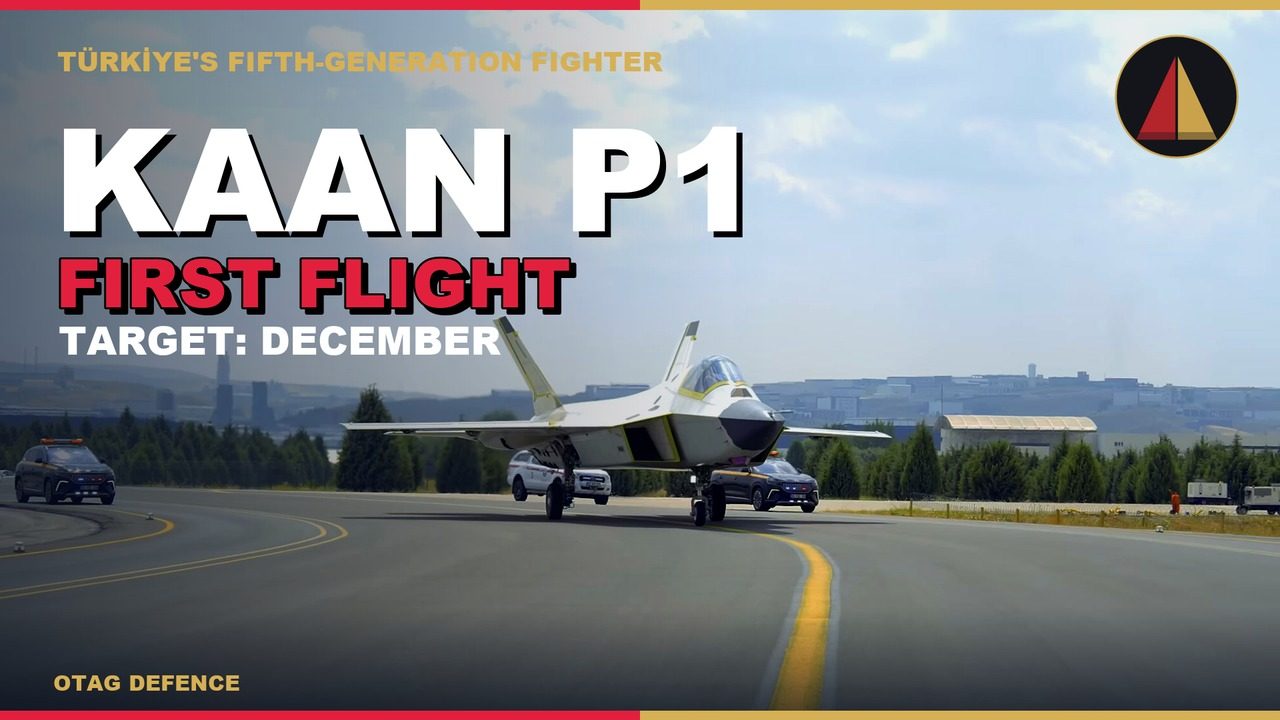
Türkiye's KAAN Stealth Fighter: Second Prototype Targets December First Flight
Otag Defence assessment“For KAAN, the question for 2026 is no longer "will it fly?" It is "how fast will the prototypes multiply?"”
 7:29
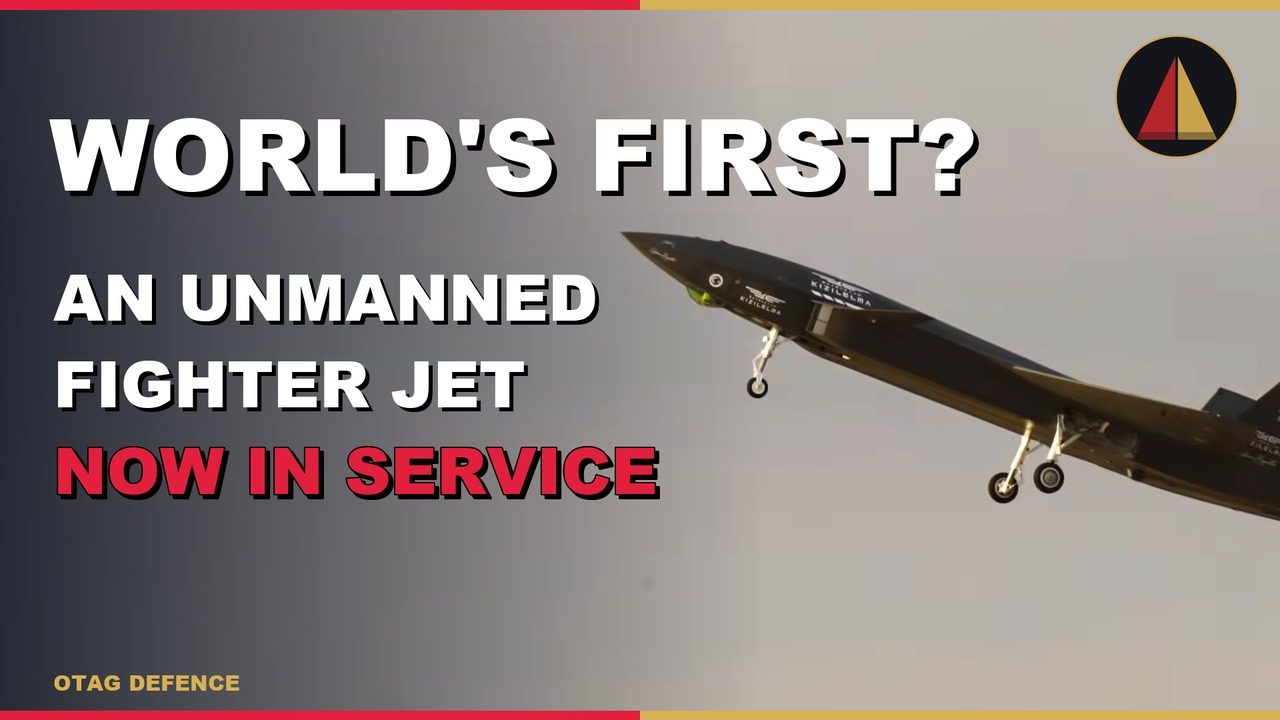
Türkiye's Kizilelma: The World's First Unmanned Fighter Jet in Service?
Is KIZILELMA really the world's first unmanned fighter in service? What does entering service actually mean? And what will Türkiye do with three aircraft?
 7:54
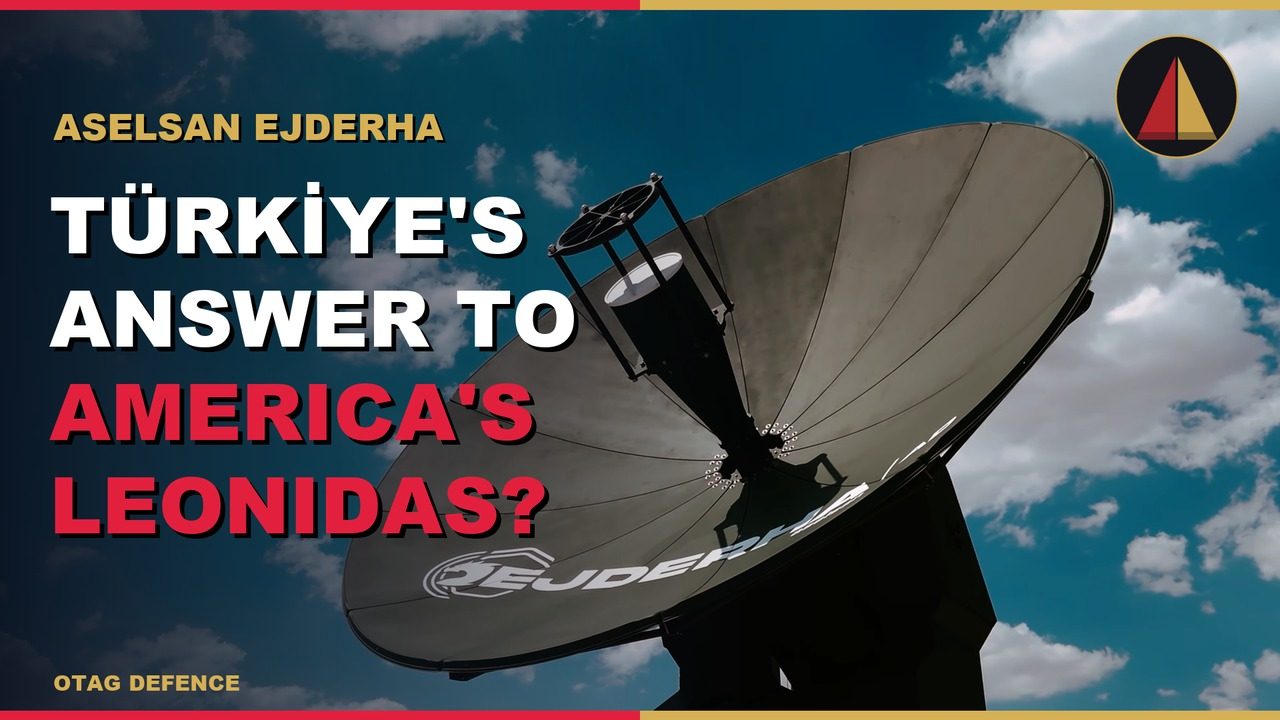
Türkiye's Answer to America's Leonidas? ASELSAN EJDERHA Explained
ASELSAN, Türkiye's largest defence electronics company, marked its 51st anniversary with a two-stage demonstration at its Gölbek Firing and Test Center near Ankara. According to the company's statement on 15 November, in the first stage EJDERHA disabled two different fibre-optic drones from about 1,000 metres. In the second stage, 51 drones launched at the same time were stopped within seconds with a single command. No missiles or bullets were used.